Scaling Collaborative Learning: Harnessing the Power of InnerSource for Courses with 250+ Students

After sharing a short article titled “Unlocking Innovation with InnerSource: Why Organisations Should Embrace” and a paper I co-authored that was presented at the HICSS conference titled “Agile and InnerSource: A Match made in Heaven and in Hell!“, my friend Nuno Seixas challenged me to share my thoughts on scaling collaborative learning with InnerSource in courses with over 250 students. I gladly accepted this challenge, and here are my insights.

Additionally, before starting, I would like to thank my colleagues Clare Dillon and Daniel Izquierdo Cortázar for their helpful review and feedback.

Scaling collaborative learning in large educational environments presents unique challenges, especially in courses with many students [1]. The InnerSource practices, inspired by open-source software methods, offer an effective strategy to address these challenges. InnerSource applies open-source principles such as transparent collaboration, shared development, and community engagement within an organisation or closed group. Based on my discussions with several professors and students, this approach is already being partially implemented in specific courses, such as Software Engineering, with promising outcomes.

In the current social media-driven world, there are noticeable gaps in communication and teamwork skills among students [2]. InnerSource can significantly narrow this gap by fostering a collaborative learning environment where students develop their soft skills, particularly in communication, teamwork, and problem-solving. These skills are highly valuable and essential for successful integration into professional organisational environments [3].

InnerSource versus Open-Source: Which is suitable for Education?

A key question when discussing InnerSource in education is: Why not opt for open source instead? Many educational initiatives encourage students to work on real-world projects, making their contributions visible to recruiters and aligning with open research and open science trends. While InnerSource and open source share benefits such as collaboration, transparency, and practical experience, there are situations where InnerSource (initially closed) proves to be more appropriate in educational settings.

  • Project Completion and Later Open-Sourcing: Some projects require a closed environment initially, before opening up once they reach maturity.
  • Private Practice Environment: Students may prefer a closed setting to experiment without exposing early-stage experiments or mistakes publicly.
  • Research Contexts: Proprietary or confidential research projects require controlled internal collaboration spaces.

These scenarios demonstrate that InnerSource serves as a safe, structured first step before transitioning students to open-source workflows.

How InnerSource Works in Education

InnerSource in educational settings involves creating shared repositories for larger, common projects accessible across all course disciplines and student groups. These repositories centralise materials such as documentation, code, assignments, and student projects, promoting transparency and collaboration. Students from various academic years are encouraged to participate by submitting pull requests, refining peers’ code, and engaging constructively in peer reviews. Professors and teaching assistants supervise this collaborative workflow, ensuring high standards of quality and consistency while helping students develop essential technical skills and critical soft skills needed for modern workplaces. Expanding this model further, courses could integrate InnerSource practices into a broader, unified educational framework, imagining the entire degree as one interconnected “mega-project”. Each course would contribute distinctly defined components, collectively forming a holistic, collaborative learning experience. Although ambitious, such integration could significantly improve interdisciplinary collaboration and student motivation [4].

Benefits of Adopting InnerSource in Large Courses

InnerSource offers several significant advantages for collaborative learning in large educational environments:

  • Increased Student Engagement and Participation: Students are more likely to engage with course material when they work on real-world projects. The collaborative structure of InnerSource mirrors professional environments, fostering intrinsic motivation and investment in the learning process [5].
  • Realistic Simulation of Industry Workflows: By adopting InnerSource practices, students follow processes similar to those used in real software development, such as shared repositories, code reviews, and issue tracking. This realistic simulation helps them become familiar with industry-standard tools and workflows, better preparing them for professional environments after graduation.
  • Improved Motivation and Accountability: InnerSource introduces structured mechanisms for recognition (e.g., contribution histories, visible pull requests, and peer feedback), which can boost motivation. Knowing that their work is visible to peers creates a natural sense of accountability and encourages students to produce higher-quality contributions.
  • Development of Soft Skills: Working within InnerSource practices helps students enhance key soft skills such as communication, collaboration, and problem-solving abilities that are invaluable in modern workplace settings and often overlooked in traditional academic courses.
  • Iterative Feedback: Peer reviews and continuous feedback loops allow students to refine their work over time. This not only enhances technical skills but also improves their ability to give and receive constructive feedback, which is an essential professional competency.
  • Enhanced Transparency and Consistency: A shared repository increases transparency and ensures consistency in course content, assignments, and evaluations. Everyone works from a common source of truth. That said, it’s essential to recognise that some students and professors may still prefer to keep detailed evaluations or grading discussions private.
  • Reduced Workload for Professors and Teaching Assistants: As students begin to mentor and support one another, the overall burden on faculty diminishes. While this model may require some upfront planning and setup, it can significantly ease the workload in the long run by leveraging structured peer mentoring.

Structured Approach to Implementation

Given the scale of implementing InnerSource in large courses, a step-by-step approach is essential. Breaking it down into manageable phases allows for smoother adoption and effective scaling.

Phase 1: Training and Onboarding

  • Provide initial training sessions for students, professors, teaching assistants, and mentors (senior students) on the tools used for collaboration (GitHub, Slack, SonarQube, among others).
  • Set up shared repositories for course projects and assignments.

Benefit: This initial phase equips all participants with the tools and knowledge needed to start working collaboratively.

Phase 2: Small-Scale Collaborative Projects

  • Introduce smaller collaborative projects where students work together in teams. Begin integrating peer review and feedback loops.

Benefit: This offers a low-pressure introduction to collaboration, helping students build confidence and familiarity with the process.

Phase 3: Peer Mentoring and Iterative Reviews

  • Develop a system for peer mentoring, where students give feedback on each other’s work, using a structured peer review process.

Benefit: Peer mentoring helps lessen the workload for professors and teaching assistants while enhancing students’ communication and review skills.

Phase 4: Larger, Cross-Disciplinary Projects

  • Scale up to larger projects that span multiple courses, encouraging interdisciplinary collaboration. This step mimics the complexity of real-world projects, where different teams work on various components.

Benefit: Students gain experience in complex, interdisciplinary teamwork, reflecting industry-level project structures.

Phase 5: Evaluation and Recognition Systems

  • Create automated systems to track and assess individual contributions to the project (e.g., GitHub analytics, automated code reviews). Implement a structured recognition system for students who contribute significantly.

Benefit: This phase boosts motivation and accountability by clearly recognising individual efforts while ensuring fair, data-driven assessments.

Addressing Main Challenges

While the benefits of InnerSource are clear, several challenges must be addressed for successful implementation in academic settings:

Time and Workload for Professors and Teaching Assistants

  • Challenge: Implementing InnerSource demands significant time from instructors and TAS, especially when evaluating individual contributions across large, shared repositories.
  • Action: Automate parts of the assessment process using analytics tools like GitHub Insights or SonarQube, which can track contributions and support data-driven evaluation of student work. Structured onboarding and gradual adoption of InnerSource practices can help reduce workload.

Resistance to Collaborative Workflows

  • Challenge: Students may be reluctant to adopt collaborative workflows, particularly if unfamiliar with peer review or open contribution models.
  • Action: Provide clear guidelines, initial training sessions, and continuous support to help students transition to collaborative work. Regular development sprints, iterative submissions, and ongoing feedback can boost acceptance and foster a culture of open collaboration.

Managing Tool Access and Security

  • Challenge: Managing access to tools (e.g., GitHub, Slack) becomes more complex in large courses, especially when students need access to specific projects or repositories.
  • Action: Use integrated platforms that simplify access management and align permissions with project roles. Assign mentors to oversee project flow, ensure security, and help students use the tools effectively.

Maintaining Consistency and Quality

  • Challenge: Ensuring consistent code quality across contributions can be challenging when multiple students work on the same repository.
  • Action: Set clear coding standards and employ automated tools like SonarQube to maintain quality. Routine peer and instructor reviews reinforce best practices and encourage meaningful participation.

Fair Assessment of Individual Contributions

  • Challenge: Accurately evaluating each student’s input within collaborative projects is a common issue.
  • Action: Use clear metrics and regular assessment checkpoints supported by analytics from version control systems and peer reviews. Implement recognition systems to reward significant contributions, effective code reviews, or valuable suggestions.

InnerSource can replicate real-world development environments in academic courses. Students may work in specialised teams (e.g., backend, frontend, testing, among others) and collaborate to integrate their work into a larger product. Submitting and resolving issues, maintaining documentation, and participating in regular sprint cycles develop technical communication skills, promote proactive behaviour, and improve team dynamics. A structured recognition system for high-quality contributions further enhances engagement and motivation.

My Thoughts on the Future of Education

The future of education is collaborative, interdisciplinary, and closely connected to real-world challenges through strong industry partnerships. To prepare students for a swiftly changing world, institutions need to go beyond traditional lectures and encourage interactive, digitally integrated learning environments. Professors and teaching assistants will become mentors and facilitators, helping students develop critical thinking, creativity, and adaptable problem-solving skills while fostering genuine teamwork. Students, in turn, must adopt self-directed exploration, collaboration, and ongoing learning as essential 21st-century skills.

One practical approach to this transformation is implementing InnerSource practices, inspired by open-source software development. By working on shared projects, whether within a single course or strategically across multiple courses, students gain not only technical knowledge but also critical soft skills such as communication, coordination, and peer review. InnerSource offers a structured, safe environment for collaborative learning, which can later expand into open-source participation, allowing students to engage with global communities, showcase their work, and build professional portfolios.

Scaling these initiatives, especially in large courses, requires careful planning, clear guidelines, effective communication, and collaborative tools to monitor progress and ensure quality. Pilot programmes or integration with existing innovation projects can quickly demonstrate value without overwhelming participants.

As AI, remote collaboration, and rapid technological change continue to reshape how we work and learn, adopting innovative educational models like InnerSource is no longer optional; it is essential. A collaborative mindset is not just a bonus; it is a fundamental competency for the modern workforce. By adopting and integrating methods beyond Agile, such as InnerSource, institutions can expand collaborative learning, develop industry-relevant skills, and better prepare students to succeed in interconnected, agile, and dynamic environments. Now is the moment to lead this change, empowering students, professors, teaching assistants, and institutions to co-create the future of learning and work.

References:

[1] P. Dillenbourg, Collaborative Learning: Cognitive and Computational Approaches. Elsevier Science Ltd, 1999.

[2] OECD, Skills for Social Progress: The Power of Social and Emotional Skills. OECD Publishing, 2020.

[3] World Economic Forum, The Future of Jobs Report 2020. World Economic Forum, 2020.

[4] D. W. Johnson and R. T. Johnson, “An educational psychology success story: Social interdependence theory and cooperative learning,” Educational Researcher, vol. 38, no. 5, pp. 365-379, 2009.

[5] M. Prince, “Does active learning work? A review of the research,” Journal of Engineering Education, vol. 93, no. 3, pp. 223-231, 2004.

Business Transformation Trinity

I was reading the article “Digital Transformation Success Depends on Agile Approach to Change” by Peter Bendor-Samuel, where the author says that companies are rushing to apply digital transformation to gain competitive advantage. Furthermore, driving the digital transformation often requires changing the company’s operating model through multiple iterative steps known as journeys. Peter Bendor-Samuel explains the benefits of using an agile approach and how this can support companies to move forward with the digital transformation. The author also states that corporate culture is the key element missing that make an organisation struggle to support the agile environment while driving their digital transformation. These ideas were so interesting that made me think deeply about the importance and strength of the relationship between digital transformation, agile and culture.

Due to its content, I decided to share it together with my thoughts on the topic. Surprisingly, as soon as I started to write my input, I realised I started writing this article. I hope you enjoy reading it the same way I enjoyed writing it. As always, it would be great to hear your thoughts on this subject.

Nowadays, companies already realised that in order to achieve a successful agile transformation, they should not limit this change to engineering departments but all business departments, including HR, finance, sales, marketing, customer support, among all others. More and more, we observe that digital transformation is becoming the new trend, leaving many people talking about this topic alongside agile transformations while companies try to achieve both. Clint Boulton states in his article “What is digital transformation? A necessary disruption” published in CIO.com that digital transformation is a basal change for how organisations deliver value to their customers. In other words, we can say that digital transformation is a revolutionary rethinking of how organisations use technology, reorganise people and processes to challenge and improve their current status quo.

Taking into consideration Peter Bendor-Samuel and Clint Boulton thoughts, we realise that agile and digital transformation are not the same. Agile focuses on how organisations deliver value iteratively to the customer while digital transformation focuses on how organisations use technology to support how value is delivered. Still, one supports the other to achieve the same goal that is delivering value. However, both authors agree that culture is so crucial that its core to achieve a successful transformation. The reason I say this is because, in traditional organisations, executives and managers are given targets that they are held accountable for, and which they cannot fail. I genuinely believe that to succeed with any transformation following the agile approach experimentation must be allowed so we can absorb the learnings from the failures and keep going forward.

During my career, agile transformation and digital transformation initiatives were driven separately, or their touchpoint was high-level. However, people started to realise that the relation between these two transformations is more substantial than initially thought — one cannot work correctly without the other. In his article Peter Bendor-Samuel Bendor-Samuel, states that companies use an agile approach to minimise risks and validate if their efforts meet the desired outcome as they move forward in their journey. Furthermore, the authors say that the key element for any digital transformation supported by an agile approach is the corporate culture. Many times, at the heart of the cultural change, we have the long-established practise of penalising failure. We should understand that there is no perfect or one solution fits all, meaning that experimentation is an essential element to understand what works or not and what can we do differently to make things work and keep improving. Therefore, companies need to celebrate their failures, that they do things to learn and test, rather than penalise failure.

All this make us think and realise that any transformation can be at risk if we take into consideration how failure is managed within the organisation by the leadership.

On a similar note, Tabrizi, Behnam et al. article “Digital Transformation Is Not About Technology” published in HBR says that digital transformation does not come in a box — or a cloud. The authors share the five key lessons that help them lead their organisation through a successful digital transformation:

  • Lesson 1: Figure out your business strategy before you invest in anything;
  • Lesson 2: Leverage insiders;
  • Lesson 3: Design customer experience from the outside in;
  • Lesson 4: Recognise employees’ fear of being replaced;
  • Lesson 5: Bring Silicon Valley start-up culture inside.

What is interesting to note is that culture is again mentioned as a key factor in these five lessons.

After having read them, these are my thoughts on each of those lessons:

  • Lesson 1: Is focused on business strategy. Leadership should first understand the problem and what is the broader business strategy instead of following the old habit of selecting a tool they have in mind to implement digital transformation.
  • Lesson 2: Many times, organisations that seek transformations (digital or otherwise) frequently bring in outside consultants who tend to apply one-size-fits-all or differently known as silver-bullet solutions. Maybe our approach should instead rely on insiders — staff who have intimate knowledge about what works and what doesn’t in their daily operations.
  • Lesson 3: Often, organisations believe they know what the customers want and need when, in reality, they should ask them.
  • Lesson 4: The organisation needs to have or coach true leaders, so they recognise and work with employees’ to overpass their fear of change and being replaced.
  • Lesson 5: Start-ups are acknowledged by their agile decision making, rapid prototyping and flat structures.

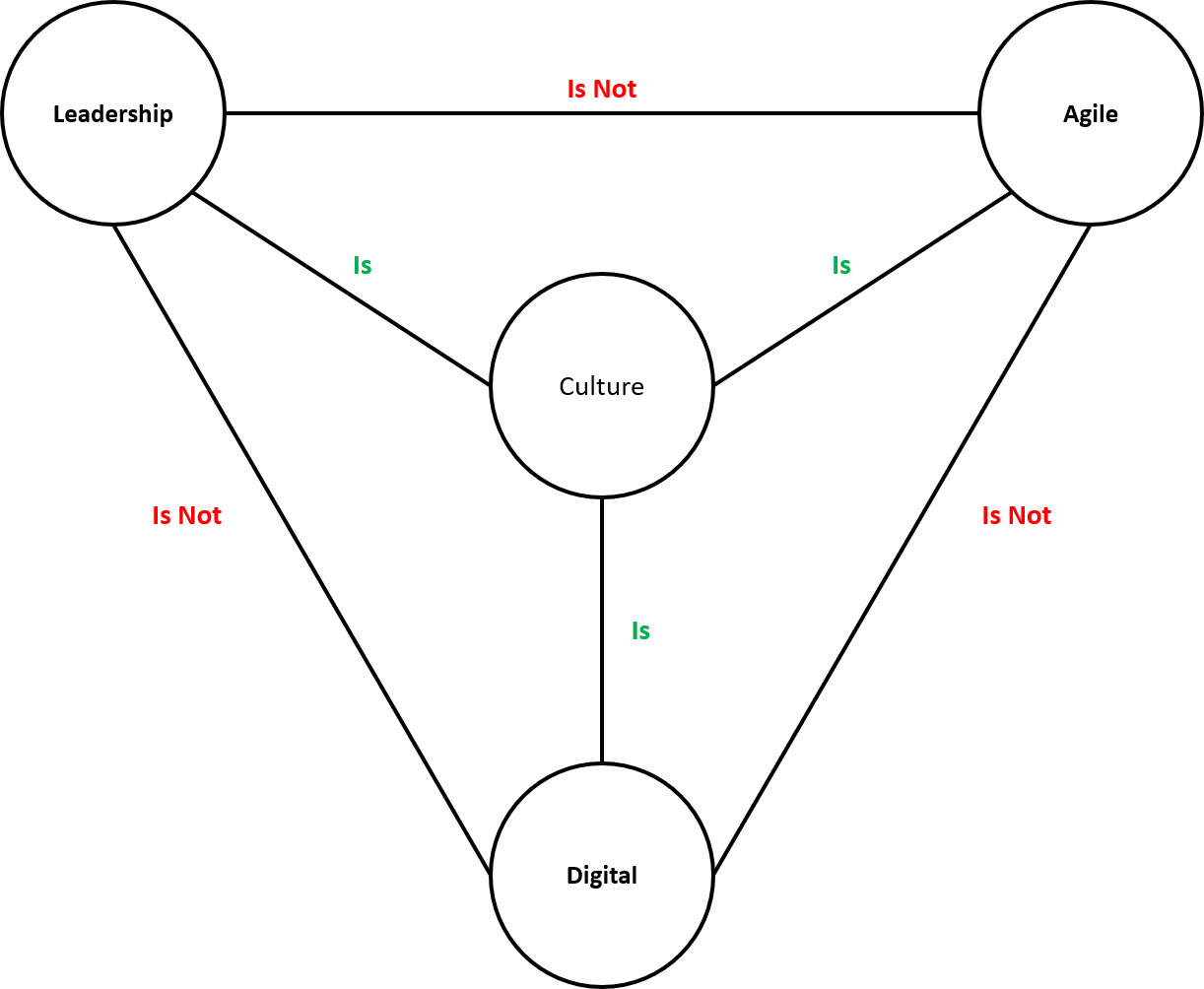
Brainstorming in front of a whiteboard helped me to have a better understanding of the relationship between agile transformation, digital transformation, leadership and culture.

After a while, an image started to become clear—the image of Business Transformation Trinity, as shown below.

Business Transformation Trinity

Business Transformation Trinity by Eduardo Ribeiro, July 2020

As we can see:

  • Leadership is not Agile;
  • Agile transformation is not Digital Transformation;
  • Digital Transformation is not leadership;
  • Culture is the centre of everything.

The triangle edges are independent, and the edges are connected by the vertices (relationships), which support each other to achieve any transformation. Furthermore, culture is the key to make transformation a success. We know that change creates discomfort since people are getting out of their comfort zone and without a proper culture in place, we will face resistance and setbacks where the worst scenario could be giving up our transformation and returning to the old ways.

In conclusion, when we are driving an agile and/or digital transformation, we need to keep in mind that all triangle edges need to be worked on iteratively. We need to do this so we can measure the impact of our implemented change, and understand if it was a success or if we need to do it differently. Last but not least, we need constant collaboration with leadership so we can learn from these small failures and not return to the long-established practise of penalizing failure.

Once more, culture is key; it needs to be in our centre of attention and addressed appropriately since even a minor change can be the trigger for the change not being accepted and ultimately not working. Following Peter Bendor-Samuel suggestion in his article, maybe what we need to do is rename the term “failure” to something else that does not create a negative impact like “learnings”. Otherwise, people can misunderstand that the transformation journey failed when actually, we have learned.

In the end, I would like to send a special “thank you” to Anett Stoica for helping me to unblock during my brainstorming moment. For the received feedback about the article, Margarida CarvalhoMike Sousa and once again Anett Stoica thank you!

#agile #agilty #digitaltransformation #leadership #culture